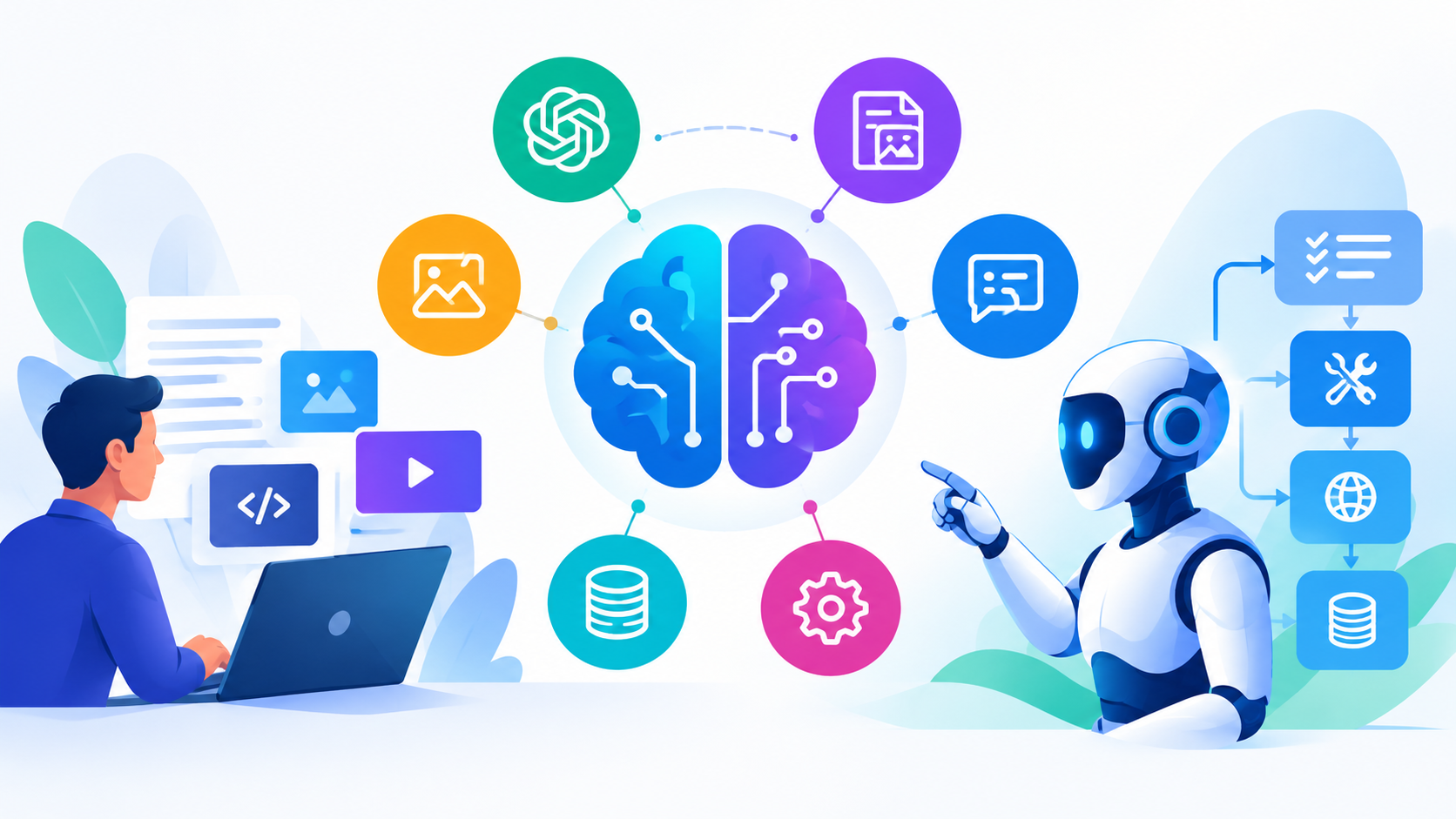
Generative AI and Agentic AI Interview Questions and Answers
Prepare for your next AI interview with these generative and agentic ai interview questions designed for intermediate and advanced learners. Explore important concepts such as Large Language Models (LLMs), Retrieval-Augmented Generation (RAG), prompt engineering, AI agents, multi-agent systems, tool calling, and real-world scenario-based problems.
At Learnomate Technologies, our Generative AI and Agentic AI Training focuses on practical concepts, hands-on learning, and industry-relevant skills to help you build your AI knowledge and prepare for technical interviews. Explore our learning resources and strengthen your understanding of modern AI technologies.
100 Generative AI and Agentic AI Interview Questions and Answers
Prepare for intermediate and advanced Generative AI and Agentic AI interviews with these technical and scenario-based questions. Topics include Large Language Models (LLMs), Retrieval-Augmented Generation (RAG), embeddings, vector databases, prompt engineering, fine-tuning, AI agents, tool calling, multi-agent systems, evaluation, security, and production deployment.
1. What is Generative AI, and how does it differ from traditional AI?
Generative AI creates new content such as text, images, code, audio, and video by learning patterns from training data. Traditional AI often focuses on classification, prediction, recommendation, or decision-making. Generative AI can also support these tasks, but its primary capability is producing new outputs.
2. What is a Large Language Model (LLM)?
An LLM is a neural network trained on large amounts of text and other supported data to understand and generate language. Most modern LLMs use Transformer architectures and predict tokens based on context. Their capabilities depend on training, model architecture, fine-tuning, and inference configuration.
3. Explain the Transformer architecture.
The Transformer architecture uses attention mechanisms to process relationships between tokens. Its main components include token embeddings, positional information, attention layers, feed-forward networks, and normalization. Transformers support parallel processing during training and are widely used in modern language models.
4. What is self-attention in an LLM?
Self-attention allows a model to assign different importance to tokens when representing a particular token. It uses query, key, and value representations to calculate contextual relationships. This helps the model use relevant information from different parts of an input sequence.
5. What are tokens, and why do they matter?
Tokens are units of text processed by a language model. They may represent whole words, word fragments, punctuation, or other symbols. Token counts affect context-window usage, processing time, API cost, and the amount of input and output a model can handle.
6. What is a context window in Generative AI?
A context window is the amount of tokenized information a model can consider during a single inference request. It may include system instructions, conversation history, retrieved documents, user input, and generated output. Large context windows help with long documents but do not guarantee perfect recall or reasoning.
7. Explain temperature and top-p sampling.
Temperature adjusts the sharpness of the model’s token probability distribution. Lower values generally produce more predictable outputs, while higher values encourage variation. Top-p sampling limits candidate tokens to a set whose cumulative probability reaches a configured threshold. Their effects depend on the model and decoding configuration.
8. What is the difference between pretraining and fine-tuning?
Pretraining teaches a model broad patterns from large datasets, often through next-token prediction or another self-supervised objective. Fine-tuning further trains the model on a narrower dataset or objective to improve behavior for particular tasks, domains, or instructions.
9. What is instruction tuning?
Instruction tuning trains a model on examples of instructions and appropriate responses. It helps the model follow user requests, respond in expected formats, and perform specific tasks more reliably. It is different from simply providing instructions in a prompt at inference time.
10. What is Reinforcement Learning from Human Feedback (RLHF)?
RLHF is a model-alignment approach that uses human preferences to help guide model behavior. A typical process includes collecting preference comparisons, training a reward model, and optimizing the language model against that reward signal. Other alignment methods can use different preference-optimization techniques.
11. What is Retrieval-Augmented Generation (RAG)?
RAG combines information retrieval with language generation. The system retrieves relevant information from external sources and provides it as context to the LLM. This can improve factual grounding, incorporate private or updated knowledge, and provide source references when the retrieval and citation pipeline supports them.
12. Explain the main components of a RAG pipeline.
A typical RAG pipeline includes document ingestion, parsing, chunking, embedding generation, indexing, query processing, retrieval, optional reranking, context construction, and LLM generation. Production systems also require access control, evaluation, monitoring, and data-refresh mechanisms.
13. What are embeddings in Generative AI?
Embeddings are numerical vectors representing text, images, or other data in a learned semantic space. Similar items often have vectors that are close under a suitable similarity measure. Embeddings are commonly used for semantic search, clustering, recommendations, and RAG retrieval.
14. What is a vector database?
A vector database stores and searches vector representations, often alongside metadata and document references. It supports similarity search using measures such as cosine similarity, dot product, or Euclidean distance. Some systems combine vector search with keyword search and metadata filtering.
15. What is the difference between semantic search and keyword search?
Keyword search primarily matches terms or lexical patterns. Semantic search uses representations of meaning to find conceptually related content, even when exact words differ. Hybrid search combines both approaches to improve retrieval across different query types.
16. How do you choose an effective chunking strategy for RAG?
Choose chunk sizes based on document structure, query types, model context limits, and retrieval quality. Preserve headings and meaningful sections, use overlap when it helps retain context, and avoid separating definitions from their explanations. Evaluate multiple strategies using representative questions and retrieval metrics.
17. What is reranking in a RAG system?
Reranking evaluates an initial set of retrieved documents and reorders them according to their relevance to the query. A cross-encoder or specialized reranking model may improve precision. Reranking adds computation, so it should be evaluated against the quality and latency requirements of the application.
18. What is hybrid retrieval?
Hybrid retrieval combines lexical search, such as BM25, with vector-based semantic search. The results are combined using methods such as reciprocal rank fusion or a learned ranking strategy. It can work well for queries containing both conceptual meaning and exact identifiers or technical terms.
19. What is the difference between RAG and fine-tuning?
RAG supplies external information to a model at inference time, making it useful for changing knowledge and source-grounded answers. Fine-tuning changes model parameters to improve task behavior, style, or domain-specific patterns. The approaches can be combined when both knowledge access and specialized behavior are required.
20. What is prompt engineering?
Prompt engineering is the process of designing instructions, context, examples, and output constraints to improve model responses. It includes task definition, role instructions, few-shot examples, structured output requirements, and evaluation. Effective prompts reduce ambiguity but cannot eliminate all model errors.
21. What is few-shot prompting?
Few-shot prompting provides a small number of input-output examples within the prompt. The examples demonstrate the desired pattern, format, or task behavior without updating model parameters. Example selection and consistency strongly influence performance.
22. What is chain-of-thought prompting?
Chain-of-thought prompting encourages structured intermediate reasoning for tasks that benefit from multiple steps. In practice, systems can request concise explanations, intermediate calculations, or verifiable subtask outputs. Reasoning-style responses must still be checked because a detailed explanation is not proof of correctness.
23. What is structured output generation?
Structured output generation constrains a model’s response to a defined schema, such as JSON with specified fields and data types. Where available, schema-constrained generation can improve format reliability. Applications should still validate outputs and handle missing fields, invalid values, and semantic errors.
24. What are hallucinations in Generative AI?
Hallucinations occur when a model generates claims that are false, unsupported, or inconsistent with the available evidence. They can result from incomplete context, ambiguous prompts, limitations in learned knowledge, or generation behavior. Retrieval, validation, abstention, and reliable sources can reduce but not completely eliminate hallucinations.
25. How do you evaluate an LLM application?
Evaluate factual correctness, relevance, groundedness, completeness, instruction following, safety, latency, and cost. Use representative test datasets, human review, deterministic checks where possible, and model-based evaluators with validation. Test both typical cases and adversarial or failure scenarios.
26. What is an AI agent?
An AI agent is a system that uses a model to interpret goals, choose actions, and interact with tools or an environment. Depending on its design, it may plan multiple steps, observe results, and adjust its next action. An agent can operate with limited autonomy or under strict human approval.
27. What is Agentic AI?
Agentic AI refers to AI systems designed to pursue goals through multi-step reasoning, tool use, planning, and feedback. Unlike a simple question-answering system, an agentic system may execute workflows and adapt based on intermediate results. Its autonomy should be matched to the risk of its actions.
28. What is the difference between Generative AI and Agentic AI?
Generative AI focuses on producing content or outputs, such as text, images, and code. Agentic AI focuses on achieving goals through decisions and actions, often using Generative AI models as a reasoning component. An agent may generate text, call tools, verify results, and continue until a stopping condition is met.
29. What are the core components of an AI agent?
Common components include a model, instructions, state or memory, a planning or decision process, tool interfaces, observation handling, and stopping criteria. Production agents also need permission controls, logging, error handling, evaluation, and mechanisms for human intervention.
30. What is tool calling in an LLM-based agent?
Tool calling allows a model to request an operation from an external function, API, database, or service. The application validates the request, executes permitted actions, and returns the result to the model. The model should not be trusted to authorize sensitive operations by itself.
31. What is the ReAct pattern in agent design?
ReAct combines reasoning-oriented decision steps with actions and observations. An agent chooses an action, receives a tool result, and uses that observation to determine the next step. This pattern can improve multi-step problem solving but needs limits to prevent unnecessary loops and repeated tool calls.
32. What is planning in Agentic AI?
Planning decomposes a high-level goal into smaller actions or subtasks with dependencies and completion criteria. Plans can be generated in advance or adjusted as observations arrive. Reliable systems validate the feasibility of each step and replan when conditions change.
33. What is the difference between an autonomous agent and a workflow?
A workflow generally follows predefined steps, rules, and transitions. An autonomous agent selects actions dynamically based on its goal and observations. Many production systems combine both approaches by using deterministic workflows for critical operations and agents for flexible reasoning or routing.
34. What is agent memory?
Agent memory stores information that may be useful across steps or sessions. Short-term memory may contain current task state and observations, while long-term memory can store selected facts or prior experience. Memory requires relevance filtering, access controls, retention policies, and protection against storing untrusted instructions as facts.
35. What is the difference between short-term and long-term memory in AI agents?
Short-term memory holds information needed for the current task or conversation, often within a context window or state store. Long-term memory persists selected information across tasks using databases, vector stores, or other storage systems. Long-term memory must be retrieved selectively and updated when information becomes outdated.
36. What is a multi-agent system?
A multi-agent system uses multiple agents or specialized roles to solve a problem collaboratively. Agents may divide tasks, exchange findings, review each other’s work, or coordinate actions. The architecture must define responsibilities, communication rules, conflict resolution, and shared-state management.
37. What is the difference between a supervisor agent and a worker agent?
A supervisor agent coordinates tasks, selects specialists, and combines results. Worker agents focus on specific activities such as retrieval, coding, analysis, or validation. This separation can improve modularity, but it introduces coordination overhead and additional failure points.
38. How do you prevent infinite loops in an AI agent?
Set maximum step counts, timeouts, token budgets, and tool-call limits. Define clear completion conditions and detect repeated actions or unchanged states. If the agent cannot make progress, it should stop, return a partial result, or request human assistance.
39. What is human-in-the-loop control in Agentic AI?
Human-in-the-loop control requires human review or approval at selected stages. It is especially important for high-impact decisions, financial transactions, access changes, and destructive operations. Approval policies should be enforced by the application, not merely suggested in the model prompt.
40. How do you measure the performance of an AI agent?
Measure task completion, factual accuracy, tool-call correctness, policy compliance, number of steps, latency, cost, recovery from errors, and human intervention rate. Evaluate the agent on realistic tasks, including incomplete information, tool failures, and adversarial inputs.
41. Scenario: A RAG chatbot provides outdated policy information. How would you fix it?
Inspect the source documents, ingestion schedule, metadata, and retrieval results. Replace obsolete documents, introduce version and effective-date filters, and ensure the retriever favors current approved sources. Add regression tests for policy-change questions and provide source dates in answers where useful.
42. Scenario: Your RAG application retrieves irrelevant documents despite using embeddings. What would you investigate?
Check document parsing, chunk size, embedding-model compatibility, query preprocessing, similarity thresholds, and metadata filters. Compare vector search with hybrid retrieval and evaluate reranking. Use a labeled query-document dataset to identify whether the failure originates in ingestion, retrieval, or answer generation.
43. Scenario: An LLM generates a confident but incorrect financial answer. How would you reduce the risk?
Ground the answer in approved financial sources, require explicit calculations from validated data, and verify critical results with deterministic code or a trusted calculation engine. Add uncertainty handling and escalation for unsupported claims. High-impact outputs should be reviewed according to the application’s risk policy.
44. Scenario: A RAG system cannot answer questions about a 500-page document. What is your approach?
Confirm that the entire document was parsed and indexed correctly. Use structure-aware chunking, metadata such as chapter and page number, hybrid retrieval, and reranking. For questions requiring information across sections, retrieve multiple relevant passages and consider a staged retrieval or summarization process with source traceability.
45. Scenario: An AI agent repeatedly calls the same API without progress. How do you resolve it?
Track tool inputs and outputs to identify repeated actions or unchanged state. Add duplicate-call detection, step limits, and explicit progress conditions. Improve tool descriptions and error feedback, and stop the task with a diagnostic message when the agent cannot advance safely.
46. Scenario: An AI agent attempts to delete customer records. What safeguards should be implemented?
Separate read permissions from destructive permissions, enforce authorization in the tool service, and require explicit approval for deletion. Use scoped credentials, validate the target records, maintain audit logs, and prefer reversible or staged deletion where possible. Never rely solely on a prompt telling the agent not to delete data.
47. Scenario: An LLM application is too expensive at scale. How would you optimize it?
Measure token usage, model latency, retry frequency, retrieval cost, and requests per task. Reduce unnecessary context, use caching where safe, route simple requests to smaller models, and batch operations when supported. Compare cost and quality through evaluation before changing models or reducing context.
48. Scenario: Your chatbot gives different answers to identical questions. Is this always a defect?
Not necessarily. Sampling settings, model versions, changing retrieved data, and context differences can cause variation. If consistency is required, control decoding settings, version prompts and sources, validate outputs against rules, and test repeated runs. Even deterministic decoding does not guarantee identical behavior across all system changes.
49. Scenario: A customer-support agent has access to order APIs but sometimes returns another customer’s order. How would you fix this?
Enforce tenant and customer-level authorization in the backend for every request. Derive identity from a trusted authenticated session instead of model-generated identifiers. Validate access before returning data, log security events, and add tests for cross-customer access attempts.
50. Scenario: A model follows malicious instructions hidden inside a retrieved PDF. What happened?
This is a prompt-injection problem. Retrieved documents contain untrusted content that the model may mistake for instructions. Treat retrieved text as data, isolate it from trusted system instructions, constrain tool permissions, validate proposed actions, and test with adversarial documents.
51. What is prompt injection, and how does it differ from jailbreaks?
Prompt injection attempts to manipulate a model through untrusted input, such as user messages, retrieved documents, or tool output. A jailbreak attempts to bypass the model’s intended safety or behavior restrictions. The categories can overlap, so defenses should include instruction hierarchy, tool controls, input handling, and output validation.
52. What is the difference between AI guardrails and application-level security?
AI guardrails inspect or constrain model inputs and outputs, such as detecting prohibited content or validating response formats. Application-level security enforces authentication, authorization, data access, network boundaries, and action permissions. Guardrails supplement rather than replace conventional security controls.
53. What is LoRA in LLM fine-tuning?
Low-Rank Adaptation (LoRA) is a parameter-efficient fine-tuning technique that trains small low-rank matrices while keeping most original model weights frozen. It reduces the number of trainable parameters and memory requirements compared with full fine-tuning. Performance depends on task, model, and configuration.
54. What is Quantization in Generative AI?
Quantization represents model weights or activations using lower-precision numerical formats. It can reduce memory usage and improve inference efficiency. The trade-off is potential quality degradation, so quantized models should be benchmarked on the target tasks and hardware.
55. What is the difference between full fine-tuning and parameter-efficient fine-tuning?
Full fine-tuning updates most or all model parameters and usually requires more compute and memory. Parameter-efficient methods such as LoRA update a smaller set of parameters or adapter modules. The choice depends on data, hardware, performance goals, and deployment constraints.
56. How do you select an embedding model for enterprise search?
Evaluate retrieval quality on domain-specific queries and documents, including acronyms, multilingual text, and technical terminology. Consider vector dimensions, latency, cost, language coverage, privacy, and licensing. Keep the embedding model consistent between document indexing and query embedding unless the retrieval system explicitly supports otherwise.
57. What is a reranker, and when should it be used?
A reranker scores candidate passages against a query after an initial retrieval stage. Use one when top-ranked results often contain irrelevant content or when high answer accuracy justifies extra latency. Measure its contribution to retrieval metrics and end-to-end answer quality.
58. What is the difference between exact and approximate nearest-neighbor search?
Exact nearest-neighbor search evaluates the distance to all eligible vectors and returns the true nearest results under the selected metric. Approximate nearest-neighbor methods use indexing structures to search more efficiently, potentially trading some recall for speed and scalability.
59. What is a multimodal LLM?
A multimodal LLM can process or generate more than one data modality, such as text, images, audio, or video. Its architecture may combine modality-specific encoders or decoders with shared representations. Supported inputs and capabilities vary by model.
60. How can Generative AI be used for code generation safely?
Treat generated code as a draft. Run static analysis, unit tests, dependency checks, security scanning, and code review before deployment. Avoid exposing secrets in prompts, use isolated execution environments for untrusted code, and verify licensing and provenance requirements.
61. What is synthetic data generation?
Synthetic data generation creates artificial records or examples that resemble selected properties of real data. It can support testing, augmentation, and evaluation when real data is limited. Synthetic data must be checked for bias, unrealistic patterns, and accidental reproduction of sensitive source information.
62. How do you prevent sensitive information from leaking through an LLM application?
Minimize sensitive data in prompts, enforce access controls before retrieval, redact or tokenize protected fields where appropriate, and use approved model endpoints and retention settings. Test for data leakage, secure logs, and apply retention policies. Output filters alone cannot guarantee privacy.
63. What is model drift in an LLM application?
Model drift refers to changes in application performance caused by shifts in data, user behavior, external knowledge, prompts, model versions, or dependencies. Monitor representative quality metrics and user feedback, maintain regression datasets, and investigate changes before deploying updates broadly.
64. What is an LLM evaluation dataset?
An LLM evaluation dataset contains representative inputs and expected outputs, reference answers, or scoring criteria. It measures behavior across defined tasks and edge cases. Good datasets include realistic examples, failure cases, adversarial prompts, and clear evaluation guidelines while avoiding leakage into training data where that matters.
65. What is the difference between precision and recall in information retrieval?
Precision measures the proportion of retrieved results that are relevant. Recall measures the proportion of all relevant results that were successfully retrieved. A RAG system must balance them: low precision introduces distracting context, while low recall may omit essential evidence.
66. What is groundedness in LLM evaluation?
Groundedness measures whether an answer’s claims are supported by the provided evidence or trusted sources. It is important in RAG and enterprise question-answering systems. Evaluation can combine automated claim checks, source verification, and human review.
67. What is the difference between offline and online evaluation?
Offline evaluation tests models and pipelines on a fixed dataset before release. Online evaluation measures behavior in real usage through monitored metrics, controlled experiments, and user feedback. Both are necessary because benchmark performance may not reflect production conditions.
68. What is LLM observability?
LLM observability tracks application behavior through traces, logs, metrics, prompts, model versions, retrieval results, tool calls, latency, and cost. Sensitive content should be redacted or access-controlled. Observability helps diagnose failures and compare changes across deployments.
69. How do you reduce latency in an LLM application?
Reduce unnecessary prompt tokens, select suitable models, optimize retrieval, cache reusable results, and stream output where appropriate. Parallelize independent operations and minimize sequential tool calls. Measure each stage separately to identify the actual bottleneck.
70. What is semantic caching?
Semantic caching reuses a previous response when a new query is sufficiently similar to a cached query. It can reduce latency and model cost for repetitive requests. Similarity thresholds, user permissions, freshness requirements, and contextual differences must be checked to avoid returning an inappropriate answer.
71. Scenario: A company wants a private assistant that answers questions from internal documents. Design the solution.
Build a RAG pipeline with secure document ingestion, parsing, chunking, embeddings, and hybrid retrieval. Apply document-level access controls before returning passages to the model, generate source-grounded answers, and monitor quality and latency. Include document refresh, audit logging, and tests for unauthorized access.
72. Scenario: Your enterprise assistant retrieves confidential documents for unauthorized users. What is the root concern?
The retrieval layer is not correctly enforcing authorization. Apply identity-aware filtering and access checks before retrieved content reaches the model. Do not rely on the LLM to hide confidential information after it has already received that information.
73. Scenario: A RAG system cites sources, but the cited passages do not support its answer. How would you fix it?
Validate that citations map to the exact retrieved passages used for generation. Require claim-level evidence checks, improve retrieval and reranking, and reject or revise claims that lack support. Test citation accuracy separately from general answer quality.
74. Scenario: An agent must research a topic, summarize sources, and create a report. How would you design it?
Use a controlled plan with stages for research, source validation, synthesis, drafting, and final verification. Restrict browsing and file-writing tools to approved actions, track sources, and validate the report before delivery. Add a human review step if the report has significant business or compliance impact.
75. Scenario: A multi-agent system produces conflicting answers. How would you resolve the issue?
Define agent responsibilities and common output schemas, then evaluate each result against evidence and task-specific criteria. Use a supervisor or deterministic arbitration process to resolve conflicts. Preserve provenance and request clarification when evidence is insufficient rather than choosing a result arbitrarily.
76. Scenario: An agent has to update employee records using an API. What controls are essential?
Authenticate with a dedicated service identity, authorize each operation, validate employee identity and field-level rules, and restrict the permitted actions. Require approval for high-impact updates, maintain an audit trail, and use safe retry and reconciliation mechanisms to prevent duplicate or incorrect changes.
77. Scenario: A tool call fails because an external service is unavailable. What should the agent do?
Classify the failure and retry only when it is transient and the operation is safe to repeat. Use bounded retries with backoff, respect service rate limits, and provide a clear failure status if recovery is unsuccessful. Avoid claiming that the requested action succeeded without confirmation.
78. Scenario: An agent gives a successful status even though the API returned an error. How would you prevent this?
Treat the actual tool response as the authoritative execution result. Validate status codes and response payloads before reporting success, and use explicit success criteria. Add tests for timeouts, partial failures, malformed responses, and downstream rejection.
79. Scenario: Your agent needs to process 10,000 invoices. Would you use one autonomous agent?
Not necessarily. Use a controlled batch-processing architecture with validation, bounded parallelism, deterministic business rules, and an agent only for tasks requiring flexible interpretation. Track each invoice independently, enforce approval policies, and reconcile totals and processing outcomes.
80. Scenario: An AI agent is making expensive tool calls to answer simple questions. What changes would you make?
Introduce intent routing and let simple queries use direct responses or lightweight retrieval. Provide clear tool-selection rules, cache suitable results, and restrict unnecessary planning steps. Monitor task success and cost to ensure optimization does not reduce answer quality.
81. What is a state machine in Agentic AI?
A state machine represents a process using defined states and transitions. In an AI workflow, states may represent planning, tool execution, validation, approval, and completion. Explicit state transitions improve control, recovery, auditability, and prevention of invalid actions.
82. Why are deterministic workflows useful in agentic applications?
Deterministic workflows enforce predictable transitions and business rules for operations that require reliability. Agents can still handle ambiguous inputs or propose next steps, while deterministic components enforce authorization, validation, approvals, and transaction boundaries.
83. What is the Model Context Protocol (MCP)?
The Model Context Protocol is a standard for connecting AI applications with external tools and context providers. It defines ways for clients and servers to expose capabilities such as tools and resources. Implementations still need authentication, authorization, input validation, and careful control of the operations being exposed.
84. What is function calling versus an autonomous agent?
Function calling allows a model to request a specific tool operation. An autonomous agent generally uses a broader control loop to select and sequence multiple actions based on intermediate results. Function calling can be one component inside an agent, but a single function call does not by itself create an autonomous agent.
85. What is the role of a planner and an executor in an agent architecture?
A planner decomposes the goal into steps and identifies dependencies. An executor performs permitted actions and collects results. The system can compare observations against the plan and revise the remaining steps when necessary.
86. How do you design memory retrieval for a long-running agent?
Store only useful, permitted information with timestamps, provenance, and relevant metadata. Retrieve memory based on the current task, identity, and access permissions. Add expiration, correction, and deletion processes, and distinguish trusted facts from unverified prior model outputs.
87. What is agent orchestration?
Agent orchestration coordinates the execution of tasks, tools, models, and agents. It manages dependencies, state, retries, timeouts, routing, and error recovery. A good orchestration design makes execution observable and limits the agent’s authority to what is necessary.
88. How do you handle partial completion in a multi-step agent task?
Persist the state and results of completed steps, identify failed and dependent steps, and resume only operations that are safe to repeat. Report which actions succeeded and which remain incomplete. Use idempotency keys or transaction controls where supported to avoid duplicate side effects.
89. What is the difference between reactive and goal-driven agents?
Reactive agents select actions primarily from current observations or predefined rules. Goal-driven agents consider a target state and choose actions intended to reach it. Practical systems often combine both, using reactive handling for known conditions and planning for more complex tasks.
90. How can an agent decide when to stop working?
Define explicit completion criteria, validation checks, resource limits, and failure conditions. The agent should stop when the goal is satisfied, the task is blocked, a risk threshold is reached, or the budget expires. It should clearly distinguish verified completion from partial progress or uncertainty.
91. Scenario: A legal-document assistant must answer only from approved documents. How would you enforce this?
Restrict retrieval to approved, version-controlled repositories and enforce document permissions. Require answers to cite supporting passages and abstain when sufficient evidence is unavailable. Maintain source versions and use human legal review for high-impact interpretations.
92. Scenario: An AI system summarizes medical documents. What design considerations are important?
Protect sensitive data, preserve source traceability, validate key facts, and clearly distinguish source information from model-generated interpretation. Test omissions, contradictions, and hallucinations. Medical summaries should follow appropriate clinical review and safety requirements rather than being treated as an independent diagnosis.
93. Scenario: A production model update causes a sudden drop in answer quality. What steps would you take?
Compare model versions, prompts, decoding settings, retrieval behavior, and dependencies against the last known-good configuration. Run regression tests and inspect representative failures. Roll back when appropriate, isolate the cause, and deploy the update only after quality and safety checks pass.
94. Scenario: Your agent is vulnerable to tool-output prompt injection. What is the solution?
Treat tool outputs as untrusted data and prevent them from overriding system policy. Validate structured results, restrict tools and permissions, and require independent authorization before sensitive actions. Test malicious responses from web pages, files, and APIs as part of security evaluation.
95. Scenario: A RAG application works well in English but poorly in other languages. How would you improve it?
Evaluate multilingual embedding support, document encoding, language detection, tokenization, and query processing. Use suitable multilingual models or language-specific indexes where needed. Build separate evaluation sets for each target language and measure retrieval and answer quality independently.
96. Scenario: Your AI agent must perform a payment. Should the model execute it directly?
The model should not independently authorize the payment. The application should validate the recipient, amount, account permissions, transaction limits, and fraud checks, then require the mandated user confirmation or approval. Execution should use a secure payment service and return a verified transaction status.
97. How do you choose between a single-agent and multi-agent architecture?
Start with a single agent when the task is manageable and shared context is simple. Consider multiple agents when tasks have clearly separated responsibilities or can be independently executed. Compare quality, coordination overhead, latency, cost, security, and maintainability before adopting a multi-agent design.
98. How do you deploy an LLM and agentic application into production?
Use version-controlled prompts and code, automated tests, secure secrets management, monitored deployment pipelines, and controlled model configuration. Add evaluation gates, rate limits, tracing, access controls, rollback procedures, and incident-response processes. Monitor quality, latency, cost, and safety after release.
99. What are the biggest challenges when building enterprise Agentic AI systems?
Key challenges include unreliable model outputs, prompt injection, data permissions, tool failures, uncontrolled costs, state management, evaluation, and auditability. Reliable systems combine constrained autonomy, deterministic business controls, robust observability, security testing, and human oversight for high-risk actions.
100. Design an enterprise AI assistant that can retrieve information, analyze data, and execute approved tasks.
Use an LLM for interpreting requests, a permission-aware RAG layer for trusted information, and controlled tools for data access and approved actions. Add planning, state management, structured outputs, deterministic validation, approval gates, and audit logs. Evaluate each component independently and test end-to-end scenarios involving incorrect data, unavailable tools, unauthorized requests, and partial failures.
Conclusion
These 100 Generative AI and Agentic AI interview questions and answers cover intermediate concepts, advanced architecture, production challenges, and scenario-based problem solving. Practice explaining the design decisions behind RAG, LLM evaluation, tool calling, agent orchestration, security, and real-world troubleshooting to prepare for technical interviews.
Learn Generative AI and Agentic AI with Learnomate Technologies
Want to develop practical skills in Generative AI and Agentic AI? Learnomate Technologies helps learners explore LLMs, RAG applications, prompt engineering, AI agents, automation, and real-world AI use cases.
For more tutorials, practical demonstrations, interview preparation, and the latest AI learning content, visit the Learnomate Technologies YouTube channel. Subscribe to stay updated with Generative AI, Agentic AI, and other in-demand technology topics.
Learnomate Technologies — Learn, Practice, and Grow with AI.