Oracle Fusion Technical Interview Questions and Answers
Oracle Fusion Technical Interview Questions and Answers: Intermediate and Advanced
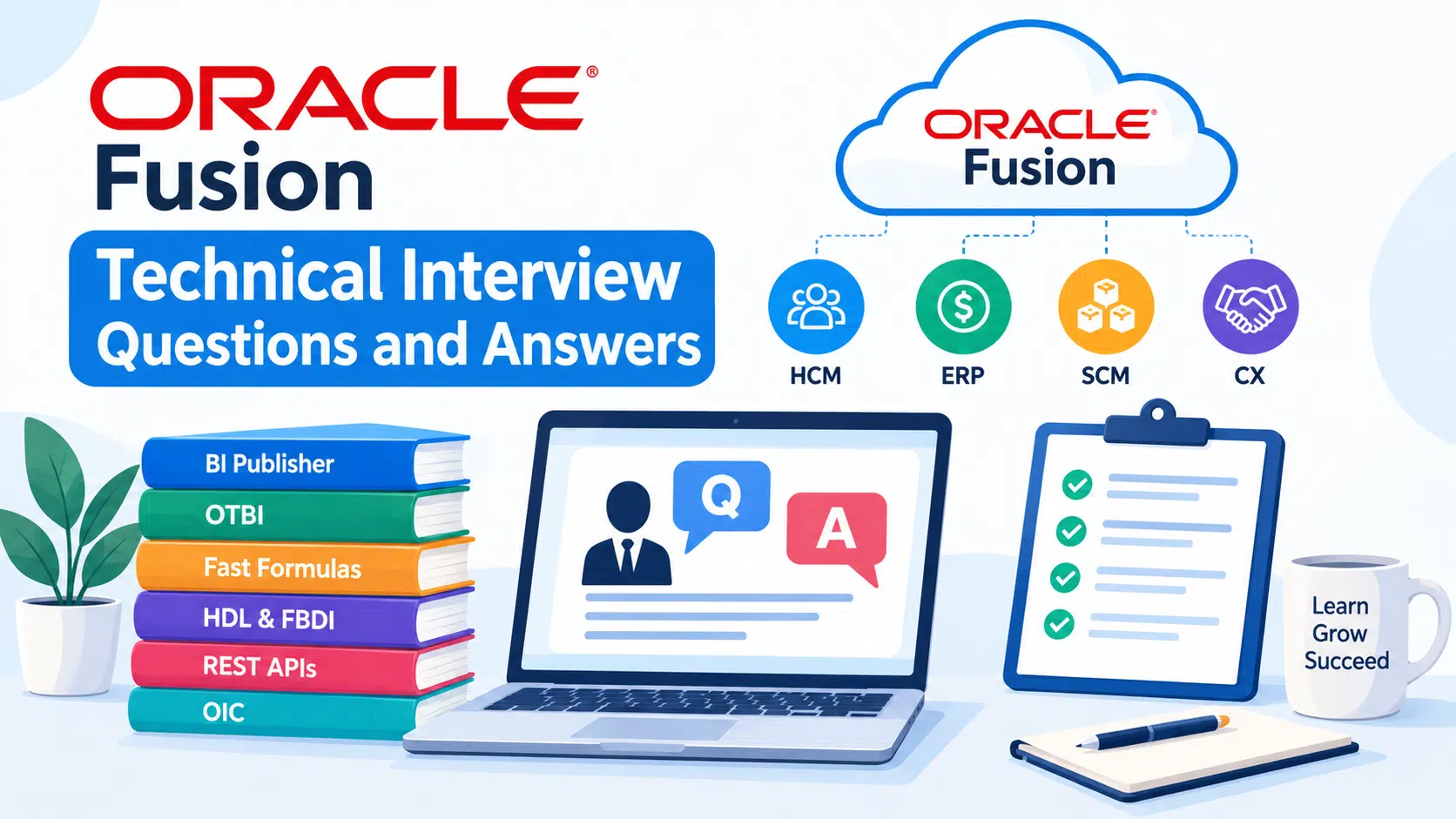
Prepare for Oracle Fusion interviews with these intermediate and advanced Oracle Fusion Technical Interview Questions and Answers. This collection covers Oracle Fusion Cloud architecture, BI Publisher, OTBI, Fast Formulas, HCM Extracts, REST APIs, SOAP services, FBDI, HDL, integrations, security, and troubleshooting scenarios.
1. What is the difference between Oracle Fusion Cloud and Oracle E-Business Suite?
Oracle Fusion Cloud is a cloud-based enterprise application platform that receives regular service updates from Oracle. Oracle E-Business Suite is traditionally deployed and managed in customer-controlled environments. Fusion Cloud uses cloud-native integration capabilities, web services, reporting tools, and application configuration features.
2. Explain the architecture of Oracle Fusion Cloud Applications.
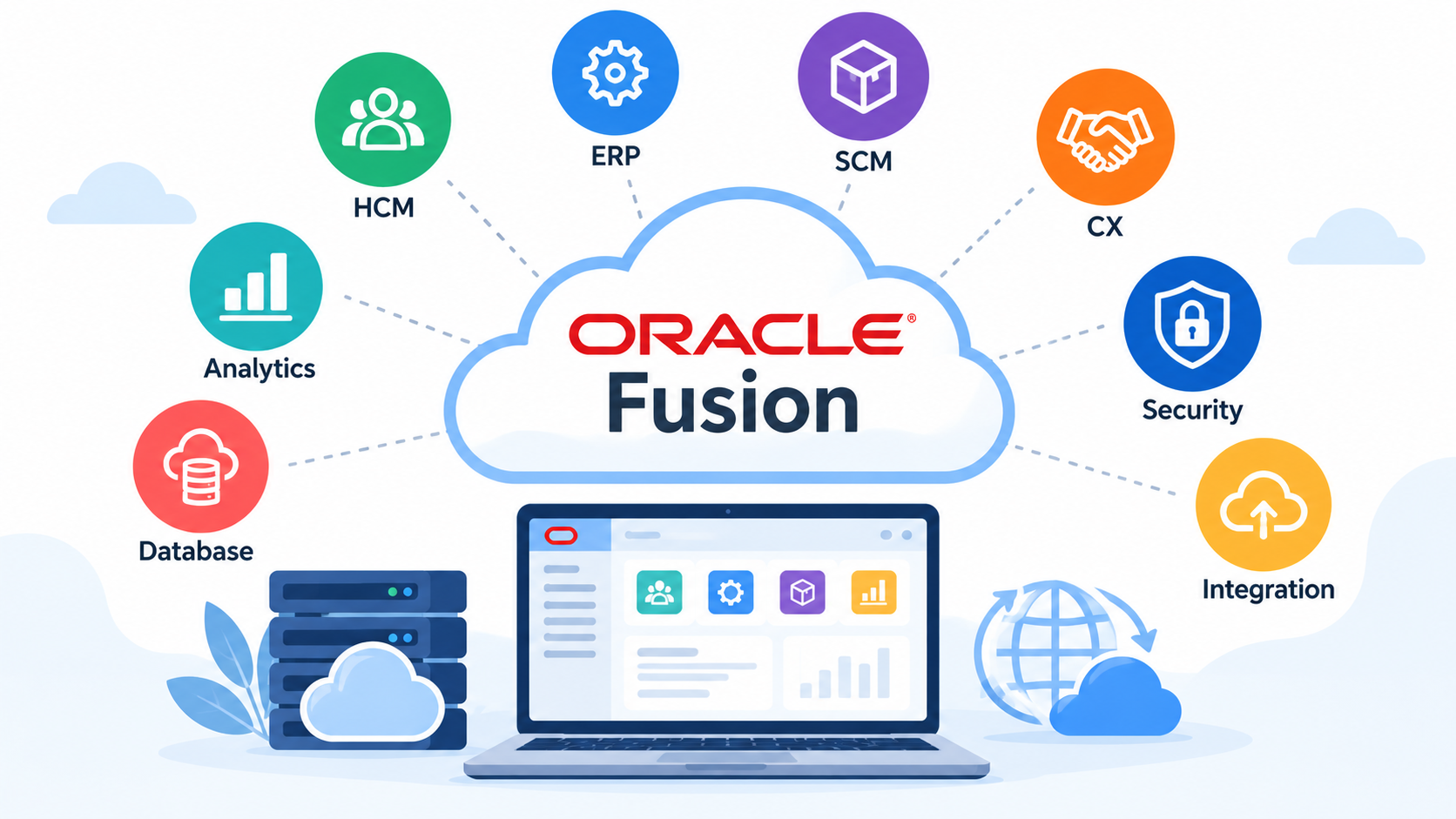
Oracle Fusion Cloud Applications provide business modules such as HCM, ERP, SCM, and CX on Oracle’s cloud infrastructure. The architecture includes application services, a data layer, security, reporting, and integration capabilities. Technical developers use supported tools and APIs to extend and integrate applications.
3. What is the difference between a sandbox and a customization in Oracle Fusion?
A sandbox provides an isolated environment for making and testing supported application changes before publishing them. Customizations modify supported application behavior or presentation using available configuration tools. The exact capabilities depend on the application and the customization framework being used.
4. What is the role of BI Publisher in Oracle Fusion Cloud?
BI Publisher is used to create formatted reports and documents using data models, layouts, and templates. It supports formats such as PDF, Excel, and other output types depending on the report configuration. It is commonly used for invoices, statements, extracts, and operational reports.
5. Explain the difference between OTBI and BI Publisher.
OTBI provides interactive, subject-area-based analysis using predefined business objects and real-time transactional reporting capabilities where supported. BI Publisher provides greater control over report layouts, data models, and formatted output. OTBI is suitable for interactive analysis, while BI Publisher is often preferred for highly formatted reports.
6. What are data models in BI Publisher?
A BI Publisher data model defines the data used by a report. It can contain SQL queries, data sets, parameters, lists of values, and other supported data structures. The report layout uses the resulting data to generate the required output.
7. How do you improve the performance of a slow BI Publisher report?
Review SQL execution plans, filter conditions, joins, and selected columns. Reduce unnecessary data retrieval, avoid inefficient functions on indexed columns where possible, and optimize parameters and data sets. Test the report with realistic data volumes and check whether the bottleneck is in SQL execution or report rendering.
8. What are bursting definitions in BI Publisher?
Bursting splits report data into separate outputs based on configured delivery keys and applies the appropriate layout, format, and destination. It can distribute individual documents through supported delivery channels such as email or file-based destinations, depending on the configuration.
9. How do you handle parameters in a BI Publisher data model?
Create parameters in the data model and reference them in the SQL query using the appropriate BI Publisher syntax. Configure default values, data types, and lists of values where required. Validate parameter inputs and test combinations to ensure the report returns correct results.
10. What are Oracle Fusion Technical Interview Questions and Answers useful for when preparing for advanced reporting roles?
They help candidates prepare for practical scenarios involving report development, data models, performance tuning, security, integrations, and error diagnosis. Candidates should understand not only the concepts but also how to investigate issues in a Fusion environment.
11. What is OTBI, and how do subject areas work?
Oracle Transactional Business Intelligence (OTBI) enables users to create analyses and dashboards using predefined subject areas. A subject area groups related business attributes and measures. The available subject areas depend on the Fusion application, assigned privileges, and enabled functionality.
12. How do you troubleshoot missing columns in OTBI?
Confirm that the correct subject area is selected and that the required attribute is available in that area. Check the user’s roles and data access, verify whether the attribute is exposed for reporting, and review the relevant application documentation. Not every database column is available directly in OTBI.
13. What is a Fast Formula in Oracle Fusion HCM?
Fast Formula is a rule-based language used to calculate values and implement business logic in supported HCM processes. It is used in areas such as payroll, benefits, absence management, compensation, and eligibility, depending on the formula type and application configuration.
14. What are the common types of Fast Formulas?
Common Fast Formula types include payroll formulas, element input validation formulas, absence formulas, benefits formulas, compensation formulas, and eligibility formulas. The available formula types depend on the HCM module and business requirement.
15. How do you debug a Fast Formula that returns an incorrect result?
Validate the formula type, input values, database items, contexts, default values, and return variables. Test the formula with representative employee data and use the available formula validation or diagnostic tools. Check effective dates and confirm that the formula is associated with the correct configuration.
16. What are database items in Fast Formula?
Database items expose supported application data to Fast Formula calculations. They allow formulas to retrieve values such as employee attributes or payroll-related information. Availability depends on the formula type, context, and application configuration.
17. What is an HCM Extract?
An HCM Extract is used to retrieve and organize HCM data for downstream systems, reports, or external parties. It can define data groups, records, attributes, parameters, and delivery options to support business requirements such as payroll-provider or benefits-provider integrations.
18. How do you troubleshoot an HCM Extract that produces no output?
Check the extract parameters, effective dates, data-group configuration, employee eligibility, security access, and process logs. Verify that the selected population contains eligible records and that the delivery configuration is correct. Review any errors in the scheduled process details.
19. What is HDL in Oracle Fusion HCM?
HCM Data Loader (HDL) is used to load and maintain supported HCM business objects in bulk. It uses structured data files and business-object-specific metadata. HDL is commonly used for employee records, assignments, departments, jobs, and other supported HCM objects.
20. What is the difference between HDL and HSDL?
HDL supports bulk loading through structured data files and is suited to technical or automated migration processes. HCM Spreadsheet Data Loader (HSDL) provides a spreadsheet-based approach for supported business objects. The best option depends on the data volume, user workflow, object support, and automation needs.
21. What is FBDI in Oracle Fusion Cloud?
File-Based Data Import (FBDI) is a mechanism for importing supported business data into Fusion applications using predefined file templates and import processes. It is commonly used in ERP and SCM data migrations and integrations. The required templates and processing steps vary by business object.
22. Explain the typical FBDI import process.
The typical process involves preparing data using the correct template, generating the required CSV files, packaging them as specified, uploading the file, and running the relevant import processes. After processing, review the import logs and error reports, correct rejected records, and reprocess them as needed.
23. What is the difference between HDL and FBDI?
HDL is primarily used for supported Oracle Fusion HCM business objects, while FBDI is used for supported import processes across applications such as ERP and SCM. They use different templates, data structures, and processing mechanisms. The appropriate tool depends on the target module and object.
24. How do you handle rejected records during a bulk data load?
Review the import error files, logs, and rejected-record details. Identify whether the issue is caused by missing mandatory fields, invalid references, incorrect formats, duplicate records, or business-rule validation. Correct the affected records and reload them using the appropriate supported process.
25. What is the difference between REST and SOAP web services in Oracle Fusion?
REST services commonly use HTTP methods and resource-oriented endpoints, often exchanging JSON data. SOAP services use XML-based messages and service contracts such as WSDL. The choice depends on API availability, required operations, payload structure, and the integration platform.
26. How do you authenticate when calling Oracle Fusion REST APIs?
Authentication depends on the configured identity and integration method. Supported options may include OAuth-based authentication and other approved mechanisms for the specific environment. Use a dedicated integration identity with the minimum required privileges, protect credentials, and follow the API’s authentication requirements.
27. What is the purpose of an Oracle Fusion REST API endpoint?
A REST API endpoint exposes supported application resources for operations such as retrieving, creating, updating, or deleting data where those operations are permitted. Developers should consult the relevant API documentation to confirm resource paths, supported HTTP methods, payload fields, and access requirements.
28. How do you troubleshoot an HTTP 401 error in a Fusion integration?
A 401 error usually indicates an authentication problem. Verify the token or credentials, token expiry, authentication configuration, endpoint URL, and authorization header. Confirm that the request uses the expected authentication scheme and that credentials are being sent securely.
29. How do you troubleshoot an HTTP 403 error?
A 403 error generally indicates that the request is understood but access is forbidden. Check the integration user’s roles, privileges, data security, and access to the target resource. Also confirm that the requested operation is supported and permitted by the service.
30. What is pagination in REST API integration?
Pagination retrieves large result sets in manageable sections rather than in one response. Oracle Fusion APIs may use documented limit, offset, or next-page links depending on the endpoint. Integrations should follow the endpoint’s pagination mechanism and continue until all required records are retrieved.
31. What is Oracle Integration Cloud (OIC)?
Oracle Integration Cloud is an integration platform used to connect Oracle applications, third-party systems, and on-premises applications. It supports integrations, adapters, mappings, orchestration, monitoring, and error handling based on the configured services and subscription.
32. What is the difference between a scheduled integration and an application-driven integration in OIC?
A scheduled integration starts according to a configured schedule. An application-driven integration is triggered by an incoming request or supported event. The choice depends on whether data should be processed periodically or in response to a business action.
33. How do you handle errors in Oracle Integration Cloud?
Use fault handlers, error notifications, monitoring, and suitable retry logic. Capture useful diagnostic details while avoiding sensitive information in logs. For recoverable failures, implement controlled retries; for business validation errors, route the record for correction rather than retrying indefinitely.
34. What is an OIC lookup?
An OIC lookup stores key-value mappings used during integration processing. It can translate values between systems, such as converting source-system codes into target-system codes. Lookups help avoid hardcoding these mappings repeatedly within integration logic.
35. How do you prevent duplicate records in an Oracle Fusion integration?
Use stable business identifiers, source-system references, idempotency controls where supported, and pre-checks before creating records. Maintain processing status and handle retries carefully. The integration should distinguish between creating a new record and updating an existing record.
36. What is an asynchronous integration?
An asynchronous integration allows the source process to submit work without waiting for the complete downstream operation to finish. Processing continues independently, and status or results can be retrieved through a supported callback, tracking mechanism, or later status check.
37. How do you optimize an integration that processes thousands of records?
Use supported bulk APIs where available, process records in controlled batches, avoid unnecessary API calls, and monitor throughput and throttling. Apply appropriate retry and checkpoint strategies, and consider parallel processing only where supported and safe for the target business objects.
38. What is a scheduled process in Oracle Fusion Cloud?
A scheduled process runs a supported application task, report, import, or batch operation. Administrators can submit processes, supply parameters, monitor statuses, and review logs or output files through the scheduled-process interface, subject to their access permissions.
39. How do you troubleshoot a scheduled process that ends in Error?
Open the process details and review its status, log files, output files, and error messages. Check the submitted parameters, access permissions, data validity, and dependencies. Resolve the underlying issue and rerun the process after confirming that rerunning it will not create duplicate or inconsistent data.
40. How do you secure Oracle Fusion integrations?
Use approved authentication methods, dedicated integration accounts, least-privilege roles, encrypted connections, and secure credential storage. Rotate credentials when required, monitor integration activity, and avoid exposing tokens or sensitive business data in logs and error messages.
41. How do you investigate a report that returns different results for two users?
Compare the users’ roles, data access, report parameters, security context, and effective-date filters. Check whether the report uses secured business views or subject areas. Different access permissions can cause users to see different subsets of the same business data.
42. What is the importance of effective dates in Oracle Fusion HCM?
Effective dates represent when a record or change is valid for business processing. They affect employee assignments, jobs, departments, compensation, and other date-effective objects. Reports and integrations must account for effective start and end dates to avoid selecting the wrong record version.
43. How do you handle date and time conversion in integrations?
Confirm the source and target date formats, time zones, and whether the field represents a date or a timestamp. Use supported conversion functions and consistent formats, such as ISO 8601 where appropriate. Test daylight-saving transitions and boundary dates when time-zone differences matter.
44. What is a flexfield in Oracle Fusion Cloud?
Flexfields provide configurable fields that extend supported application data structures without changing the underlying application code. Descriptive Flexfields capture additional attributes, while Extensible Flexfields support additional attributes in designated business objects with a configurable structure.
45. What is the difference between a Descriptive Flexfield and an Extensible Flexfield?
A Descriptive Flexfield (DFF) adds configurable attributes to supported application records, often using context-sensitive segments. An Extensible Flexfield (EFF) supports more structured extensions for designated business objects, potentially including multiple contexts and pages. Availability and behavior depend on the application object.
46. What should you verify after deploying a flexfield change?
Verify that the required segments and contexts are configured, the flexfield is deployed, and the relevant privileges are assigned. Test data entry, validation, reporting, and integration behavior. Confirm that downstream processes correctly handle the newly added attributes.
47. What is the role of value sets in Oracle Fusion?
Value sets control or validate the values users can enter in supported flexfield segments and other configurations. Depending on the value-set type, values may be predefined, independent, dependent, or derived through a supported query. Correct configuration helps maintain data consistency.
48. How do you troubleshoot a value set that does not display expected values?
Check the value-set definition, validation type, bind variables, dependent values, effective dates, and any query conditions. Verify that the expected source records exist and that the configuration has been saved and deployed where required. Test using the same context as the affected user.
49. What are the key considerations when migrating Oracle Fusion configurations between environments?
Identify the supported migration mechanism for each configuration type, document dependencies, and verify source and target environments. Move configurations through the approved process, validate them after migration, and test security, integrations, reports, and business workflows before production use.
50. How do you troubleshoot an integration that works in a test environment but fails in production?
Compare endpoint URLs, credentials, roles, network access, lookup values, configuration versions, and available API features. Review production logs and response payloads, and check for differences in data volume or business rules. Avoid assuming the same configuration exists in both environments.
51. How do you design a reliable retry mechanism for failed API calls?
Classify errors into transient and permanent failures. Use bounded retries with backoff for transient issues such as temporary service failures or throttling, while routing validation and authorization errors for correction. Ensure retry operations are idempotent or otherwise protected against duplicate transactions.
52. How do you troubleshoot a slow REST API response from Oracle Fusion?
Measure response times and inspect request parameters, payload size, filters, expansions, and pagination. Retrieve only the required attributes, avoid repeated requests for the same data, and review service limits or throttling indicators. Use supported bulk operations when suitable and available.
53. What is data validation in an Oracle Fusion data migration?
Data validation checks that migrated records meet business rules and match expected source values. It includes record counts, mandatory-field checks, reference validation, totals reconciliation, and sample-record comparison. Validation should be performed after import and before business sign-off.
54. How do you troubleshoot a BI Publisher report that generates an empty PDF?
Check whether the data model returns rows, whether parameters filter out all records, and whether the layout references the correct XML elements. Review the report output, data model execution, and formatting rules. Also verify permissions and any conditional display logic in the template.
55. What is the difference between a data security policy and a job role?
A job role groups functional duties and privileges that determine which actions a user can perform. Data security controls which records or data instances the user can access. Both must be configured correctly for a user to perform an action on the intended data.
56. How do you approach troubleshooting a production issue in Oracle Fusion?
Establish the scope and business impact, reproduce the issue where safe, and collect timestamps, request identifiers, process logs, and relevant error messages. Check recent changes and dependencies, isolate the cause, apply an approved fix, and validate the result. Document the resolution and preventive actions.
57. How do you design a scalable data extraction process from Oracle Fusion?
Choose a supported extraction mechanism based on the data object and volume. Use incremental extraction when supported, apply filters and pagination, maintain checkpoints, and handle updates or deletions according to the source API’s behavior. Monitor throughput and reconcile extracted data with the source.
58. What are common challenges in Oracle Fusion Cloud integration projects?
Common challenges include authentication, data mapping, data-quality issues, API limits, inconsistent reference values, effective dating, duplicate processing, and environment differences. A robust design includes validation, monitoring, error handling, secure credential management, and reconciliation.
59. How do you prepare for advanced Oracle Fusion technical interviews?
Practice reporting, REST and SOAP integrations, HCM data loads, Fast Formulas, security, and troubleshooting scenarios relevant to the target role. Be ready to explain your design decisions, investigate sample errors, discuss performance improvements, and describe how you validate production changes.
60. What skills should an Oracle Fusion Technical Consultant develop?
An Oracle Fusion Technical Consultant should understand the relevant Fusion modules, reporting, integration tools, data migration, security, and application configuration. Strong debugging, documentation, testing, and communication skills are also important for delivering reliable technical solutions.
Conclusion
These Oracle Fusion Technical Interview Questions and Answers cover intermediate and advanced concepts that can help candidates prepare for technical interviews and practical project scenarios. Focus on understanding the underlying concepts, testing configurations, and explaining troubleshooting steps clearly. Learnomate Technologies provides technical learning resources to help professionals strengthen their Oracle Fusion skills.
Stay updated with the latest tutorials, expert insights, practical demonstrations, and hands-on learning videos from Learnomate Technologies. Explore our educational content to enhance your technical skills, learn industry-relevant concepts, and grow your career.
Subscribe to our YouTube channel and turn on notifications so you never miss a new video!