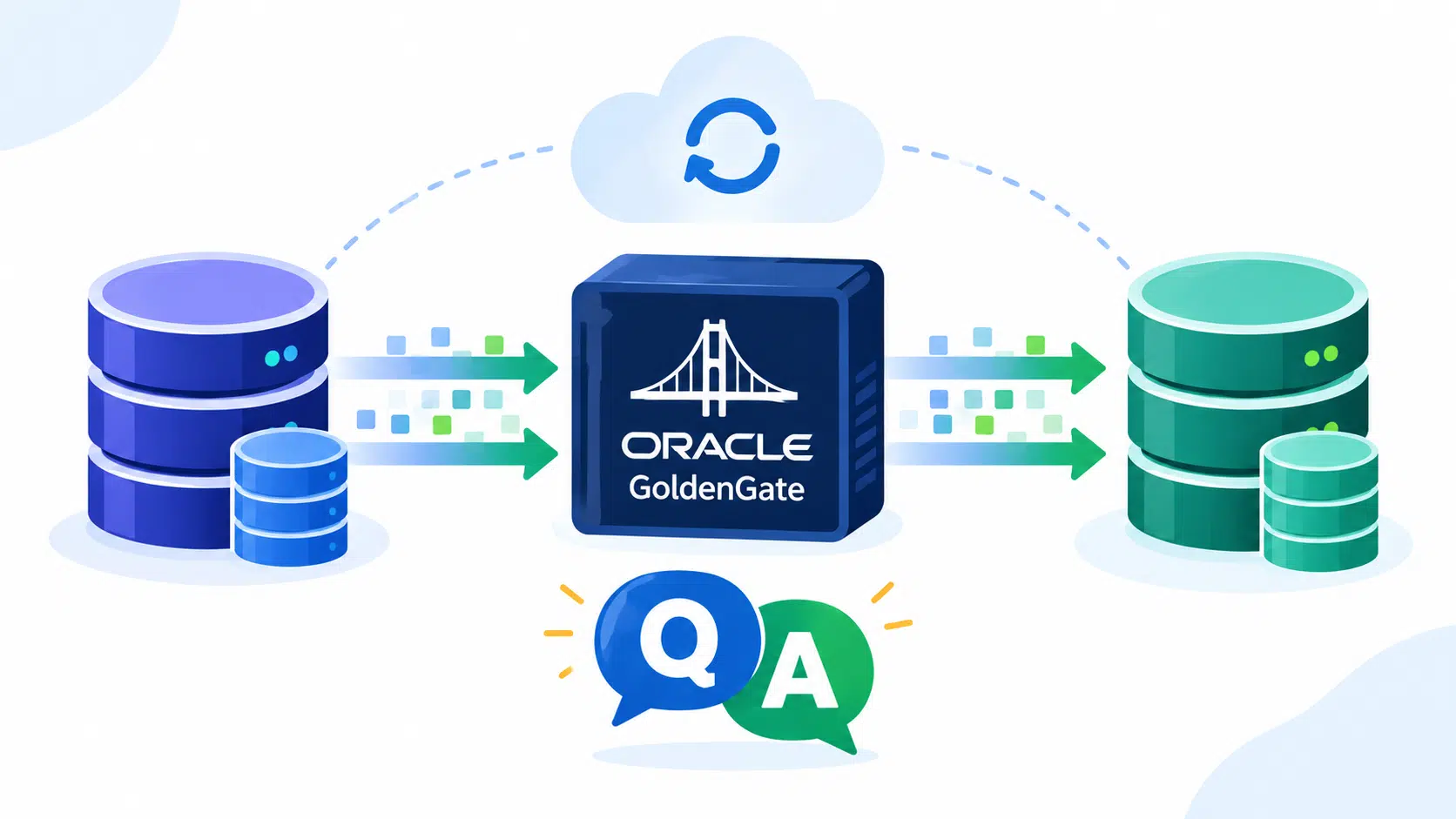
Golden Gate Interview Question & Answer
Oracle GoldenGate Interview Questions: Prepare for Real-World DBA Scenarios
Preparing for your next database administration interview? These Oracle GoldenGate Interview Questions will help you strengthen your understanding of real-time data replication, change data capture (CDC), Extract and Replicat processes, performance tuning, replication lag, and troubleshooting.
Whether you are an Oracle DBA, GoldenGate administrator, or database migration professional, this collection covers intermediate and advanced concepts along with practical, scenario-based questions. Use these questions to improve your technical knowledge, prepare for production support challenges, and build confidence for Oracle GoldenGate job interviews.
Learnomate Technologies focuses on practical database training to help professionals develop the skills needed to work with replication, database migration, high availability, and data integration environments.
1. How Do You Troubleshoot Replication Lag in Oracle GoldenGate?
Replication lag can occur due to high transaction volume, slow target database performance, network delays, or inefficient Extract and Replicat processing. During troubleshooting, check process status, lag statistics, report files, trail file generation and consumption, and target-side wait events. Identify whether the delay originates at capture, trail transport, or Replicat before applying corrective actions.
2. What Is the Difference Between Classic and Integrated Extract in Oracle GoldenGate?
Classic Extract reads supported transaction log information using GoldenGate’s traditional capture mechanism, while Integrated Extract works with Oracle Database log mining services to capture changes. Integrated capture can provide better integration with Oracle Database features and is commonly used in supported Oracle Database environments. The appropriate mode depends on the database version, GoldenGate release, and configuration requirements.
3. How Do You Handle an Abended Replicat Process Without Losing Data?
First, review the Replicat report, error messages, discard files, and checkpoint information to identify the cause of the failure. Correct the underlying issue, such as a data mapping error, missing object, constraint violation, or permission problem. Before restarting, verify the checkpoint and transaction state, and follow the appropriate recovery procedure to avoid skipping or duplicating transactions.
4. What Is the Role of Checkpoints and Trail Files in Oracle GoldenGate Recovery?
Trail files store captured change records for subsequent processing, while checkpoints record processing progress. Extract, transport, and Replicat components use checkpoint information to resume from an appropriate position after a failure. Understanding trail sequence numbers, RBA positions, and checkpoint files is essential when diagnosing recovery issues and maintaining replication consistency.
5. How Do You Troubleshoot Missing or Incomplete Data at the Target Database?
Start by confirming that supplemental logging and capture configuration cover the required tables and columns. Check Extract and Replicat reports, trail contents, table mappings, filtering rules, operation types, and discard files. Also verify that the target schema, data types, constraints, and permissions are compatible with the incoming changes. Use a controlled data comparison to identify where the records are being omitted.
6. How Do You Configure Oracle GoldenGate for High-Volume Transaction Processing?
For high-volume workloads, evaluate transaction sizes, capture throughput, trail I/O, network capacity, and target database performance. Review batching and transaction-processing options, tune supported memory and cache settings, and consider parallel Replicat where appropriate. Test any tuning changes under a representative workload and monitor lag, throughput, resource consumption, and transaction ordering requirements.
7. What Is the Difference Between Integrated Replicat and Parallel Replicat?
Integrated Replicat uses Oracle Database inbound server functionality to apply changes, while Parallel Replicat uses coordinated parallel processing to increase apply throughput. Parallel Replicat can improve performance for suitable workloads, but dependencies, transaction ordering, database compatibility, and supported GoldenGate versions must be considered before selecting an apply mode.
8. How Do You Resolve Duplicate Records or Unique Constraint Errors in Replicat?
Investigate whether the error is caused by pre-existing target data, duplicate source operations, incorrect restart or recovery procedures, key-column mismatches, or multiple replication paths applying the same changes. Review the error details and transaction history before deciding on a correction. Avoid simply ignoring constraint errors, as doing so can conceal data inconsistencies.
9. How Do You Perform an Initial Data Load Along With Ongoing Change Replication?
An initial load copies existing source data to the target, while change data capture keeps the target synchronized with ongoing transactions. A reliable migration plan coordinates the load with a consistent capture position or supported instantiation method, then applies changes from the correct point. Validate row counts, key data, replication lag, and application consistency before cutover.
10. How Do You Plan an Oracle GoldenGate Migration With Minimal Downtime?
Plan source and target compatibility, initial data synchronization, ongoing change replication, validation, application connection changes, and rollback procedures. Monitor replication lag and resolve outstanding errors before cutover. Perform a controlled switchover only after confirming data consistency and application readiness. Actual downtime depends on the workload, migration design, testing, and operational requirements.
11. How Do You Identify Whether Replication Lag Occurs in Extract or Replicat?
Compare capture lag, trail file generation, trail consumption, and apply lag using GoldenGate monitoring commands and report files. If Extract is delayed, investigate source transaction volume and capture performance. If Replicat is delayed, check target database waits, SQL execution, constraints, and apply throughput.
12. What Is the Difference Between Heartbeat Tables and Lag Statistics?
Heartbeat tables track the movement of heartbeat records through replication paths and help measure end-to-end latency. Lag statistics report processing delays for GoldenGate components. Heartbeat monitoring is useful for identifying delays across multiple replication stages.
13. How Do You Handle Long-Running Transactions in GoldenGate?
Check open transaction information, transaction sizes, capture checkpoints, and available transaction memory. Long-running transactions can delay checkpoint advancement and increase recovery requirements. Investigate the source transaction before changing transaction-handling parameters.
14. What Happens When GoldenGate Trail Files Accumulate Faster Than Replicat Can Process Them?
Trail accumulation indicates that downstream processing may be slower than capture. Check Replicat lag, target database performance, disk capacity, network throughput, and transaction volume. Increase processing capacity only after identifying the bottleneck and validating parallel apply compatibility.
15. How Do You Troubleshoot an Extract Process That Stops Capturing Changes?
Review the Extract report, error logs, database connectivity, archive log availability, checkpoint position, and required privileges. For integrated capture, also inspect the capture process and database log mining configuration. Correct the root cause before restarting the process.
16. What Is Supplemental Logging, and Why Is It Important?
Supplemental logging records additional information in redo logs so GoldenGate can identify and replicate changed rows correctly. Primary key, unique key, or suitable all-column logging may be required depending on the table and replication design. Verify the logging configuration for all replicated objects.
17. How Do You Replicate Tables That Do Not Have a Primary Key?
Evaluate whether a suitable unique key exists. If not, GoldenGate may use configured supplemental logging and available row-identification information, but updates and deletes can become less efficient or ambiguous. Define a reliable key strategy and test the behavior before production deployment.
18. How Do You Replicate Only Selected Tables From a Schema?
Configure appropriate TABLE or MAP rules in the relevant Extract and Replicat parameter files. Use schema-level inclusion or exclusion rules when suitable, and verify wildcard behavior and filtering conditions. Confirm that all required tables are included in both capture and apply configurations.
19. How Do You Exclude Specific Rows From Replication?
Use supported FILTER or WHERE conditions in the appropriate GoldenGate mapping configuration. Ensure the filtering expression uses valid column names and compatible data types. Test inserts, updates, and deletes to confirm that filtering produces the intended target data.
20. How Do You Replicate a Table When the Source and Target Column Names Differ?
Configure column mapping with the appropriate COLMAP rules in the Replicat MAP statement. Explicitly map columns where names, ordering, or expressions differ. Validate data types, nullable columns, default values, and target constraints before enabling production replication.
21. How Do You Handle Different Table Structures Between Source and Target?
Review source and target metadata, column mappings, data types, keys, and constraints. Use explicit mapping rules where supported and ensure the target structure can accept incoming changes. Structural differences should be tested carefully because incompatible changes may cause Replicat errors or data loss.
22. What Is the Purpose of a GoldenGate Discard File?
A discard file records operations that could not be processed under the configured error-handling behavior. It can help diagnose mapping failures, invalid data, and target constraint violations. Review the recorded details and correct the underlying problem rather than treating the discard file as a substitute for recovery.
23. How Do You Handle DDL Replication in Oracle GoldenGate?
DDL replication depends on the GoldenGate version, database platform, supported DDL operations, and configuration. Verify the applicable DDL support and parameters, and plan schema changes carefully. Test changes in a nonproduction environment because unsupported or mismatched DDL can interrupt replication.
24. How Do You Troubleshoot a Table That Is Missing From the Replication Configuration?
Check Extract capture rules, Replicat MAP statements, wildcard expansion, table registration requirements, supplemental logging, and process reports. Confirm that the table was included in the intended replication path and that its changes are present in the trail file.
25. What Is the Difference Between a GoldenGate Parameter File and a Checkpoint File?
A parameter file defines how a GoldenGate process captures, transports, or applies changes. A checkpoint file or checkpoint record tracks processing progress so the process can resume after interruption. Parameter changes alter behavior, while checkpoint information supports recovery and continuity.
26. How Do You Safely Modify GoldenGate Parameters in a Running Environment?
Determine whether the parameter supports dynamic changes or requires a process restart. Back up the current configuration, validate syntax, assess the impact on checkpoints and replication, and schedule disruptive changes appropriately. Verify process status and lag after applying the modification.
27. How Do You Investigate an ORA Error Reported by Replicat?
Review the complete GoldenGate error, associated Oracle error, report file, target SQL operation, and affected table. Determine whether the cause is permissions, constraints, invalid objects, incompatible data, or database availability. Correct the root cause and follow a controlled restart or recovery procedure.
28. How Do You Manage Replication for Partitioned Tables?
Confirm support for the partitioning features in the source database, target database, and GoldenGate release. Configure table mapping and logging appropriately, and test partition maintenance operations where relevant. Validate inserts, updates, deletes, and partition movement behavior.
29. How Do You Replicate Sequences Between Oracle Databases?
Sequence replication requires a strategy appropriate to the application and GoldenGate release. Evaluate supported sequence handling, independent source and target sequence generation, cache settings, and possible value collisions. For applications generating identifiers on multiple systems, design a collision-resistant strategy.
30. How Do You Handle Large Objects Such as CLOB and BLOB in GoldenGate?
Check GoldenGate and database-version support for the relevant LOB types, logging requirements, and replication configuration. Large objects can increase trail volume and apply time. Test representative LOB sizes and operations, and monitor memory, storage, and replication lag.
31. How Do You Configure Replication Between Different Oracle Database Versions?
Verify the supported source and target database versions, GoldenGate release compatibility, capture mode, data types, and feature restrictions. Review upgrade and migration requirements before configuring Extract and Replicat. Test schema compatibility and representative workloads before production use.
32. How Do You Replicate Data Across Different Database Platforms?
Confirm that the chosen GoldenGate release supports both source and target platforms. Configure the appropriate capture and delivery components, map data types and objects, and validate target-specific constraints. Cross-platform replication may require platform-specific deployment and configuration steps.
33. What Is the Purpose of the GoldenGate BATCHSQL Parameter?
BATCHSQL can group suitable database operations into batches to improve Replicat apply throughput. It may not benefit every workload, especially where dependencies, errors, or transaction characteristics limit batching. Benchmark the effect and verify error-handling behavior before using it in production.
34. How Do You Diagnose High CPU Usage by GoldenGate Processes?
Identify the process consuming CPU and correlate it with transaction volume, mapping expressions, filtering, conversion work, and database activity. Review process statistics and operating system metrics. Apply tuning changes incrementally and measure throughput and lag after each change.
35. How Do You Manage Trail File Disk Space?
Monitor trail directory usage, generation rates, downstream consumption, and filesystem capacity. Configure supported trail retention and purge policies so files are removed only when no longer required by recovery or other consumers. Maintain sufficient capacity for peak workloads and outage scenarios.
36. What Is the Difference Between Local Trails and Remote Trails?
Local trails are created on the system where the relevant GoldenGate process writes them, while remote trails are delivered to another system through the configured transport path. Remote trail delivery supports distributed replication architectures. Network reliability, storage capacity, and trail continuity should be monitored.
37. How Do You Monitor GoldenGate Processes Using Admin Client Commands?
Use the commands supported by your GoldenGate deployment to inspect process status, lag, statistics, reports, and configuration. In Microservices Architecture, Admin Client provides commands for managing deployments and processes. Command syntax differs from the classic GGSCI environment, so use the documentation for your installed release.
38. How Do You Diagnose Network Delays Between GoldenGate Source and Target?
Compare capture throughput with remote trail delivery and target consumption. Check network latency, packet loss, bandwidth, firewall rules, and Distribution or Receiver Service status where applicable. Confirm that network delays, rather than slow target apply, are responsible for the backlog.
39. How Do You Recover From a GoldenGate Process Failure After a Server Restart?
Check deployment availability, process status, database connectivity, trail accessibility, checkpoints, and required services. Confirm that recovery begins from the correct processing position. Start components according to the deployment’s operational procedures and verify that replication resumes without gaps.
40. How Do You Validate Data Consistency Between Source and Target?
Compare row counts, key ranges, checksums, selected column values, and business-level totals. Account for ongoing transactions so comparisons use consistent data points. Investigate mismatches and confirm that pending trail records have been applied before declaring synchronization complete.
41. How Do You Handle GoldenGate Replication During Planned Database Maintenance?
Review the maintenance impact on capture, transport, and apply services. Confirm archive log retention, trail storage, checkpoints, and restart procedures before maintenance begins. Afterward, validate process health, lag recovery, and data consistency.
42. How Do You Replicate Only Specific Operations Such as INSERT and UPDATE?
Use supported operation filtering in the relevant capture or apply configuration. Carefully test the behavior for inserts, updates, deletes, and transactions containing multiple operation types. Confirm that excluding an operation will not leave the target inconsistent with the intended business requirements.
43. How Do You Configure GoldenGate for Multiple Schemas?
Define the required schema-level or table-level capture and mapping rules, with explicit exceptions where necessary. Validate privileges, supplemental logging, target ownership, and naming conventions for each schema. Use a controlled test to ensure the intended objects are replicated without unwanted tables.
44. How Do You Troubleshoot Invalid Column Mapping Errors?
Compare source and target metadata, inspect COLMAP expressions, and review the Replicat report for the failing operation. Verify column names, data types, expressions, nullability, and target object definitions. Correct the mapping and confirm that previously failed records can be recovered safely.
45. What Is the Importance of GoldenGate Report Files During Troubleshooting?
Report files provide process-specific information about startup, configuration, processing activity, warnings, and errors. They help correlate failures with particular tables, operations, or transaction positions. Reviewing the report alongside database and deployment logs provides a more complete diagnostic picture.
46. How Do You Manage Replication for High-Transaction OLTP Databases?
Measure transaction rates, transaction sizes, source capture performance, trail throughput, and target apply capacity. Optimize the actual bottleneck, evaluate suitable parallel apply strategies, and ensure that key dependencies are preserved. Stress-test peak workloads and outage recovery before deployment.
47. How Do You Handle Target Tables With Additional Constraints?
Review primary keys, unique constraints, foreign keys, triggers, and check constraints that may reject incoming changes. Determine whether source and target business rules are aligned. Correct structural differences or data issues rather than disabling constraints without an approved integrity plan.
48. How Do You Perform a Controlled GoldenGate Process Restart?
Check process status and the reason for stopping it. Use the appropriate stop and start commands for the deployment type, verify checkpoint continuity, and inspect the process report after restart. Avoid deleting checkpoints or repositioning a process unless a documented recovery procedure requires it.
49. How Do You Troubleshoot Missing Archive Logs for Integrated Extract?
Determine the required capture position and identify which archive logs are missing or inaccessible. Check database archive destinations, retention, permissions, and capture recovery status. Restore required logs where possible and follow Oracle GoldenGate recovery guidance if the logs needed for capture are no longer available.
50. How Do You Document an Oracle GoldenGate Production Incident?
Record the incident timeline, affected processes, source and target systems, lag measurements, error messages, trail positions, diagnostic evidence, root cause, and recovery actions. Include data-validation results and preventive measures. This documentation supports repeatable troubleshooting and operational audits.
51. How Do You Design an Oracle GoldenGate Architecture for Disaster Recovery?
Design the replication topology around recovery point objectives, recovery time objectives, network availability, database compatibility, and application dependencies. Define capture, transport, apply, monitoring, and failover procedures. Test recovery and resynchronization so the architecture meets business continuity requirements.
52. How Do You Configure Bidirectional Replication Between Oracle Databases?
Configure separate replication paths for each direction and define conflict prevention, key generation, and transaction ownership rules. Prevent replication loops using supported configuration techniques. Test simultaneous updates, deletes, inserts, and network interruptions before enabling bidirectional production traffic.
53. How Do You Resolve Data Conflicts in Active-Active GoldenGate Replication?
First identify the conflict type, such as simultaneous updates, duplicate inserts, or delete-versus-update conflicts. Define business-approved conflict detection and resolution rules, including transaction priority or ownership where applicable. Validate the rules under concurrent workloads and maintain evidence of resolved and unresolved conflicts.
54. How Do You Prevent Replication Loops in a Multi-Database Topology?
Design clear replication paths and use supported loop-prevention mechanisms, such as appropriate filtering or replication metadata strategies. Avoid configurations in which changes repeatedly circulate between systems. Test updates originating from every participating database and verify that each transaction is applied only as intended.
55. How Do You Tune Integrated Replicat for High-Throughput Workloads?
Measure apply throughput, database waits, dependency constraints, transaction sizes, and available CPU and memory. Review supported integrated Replicat tuning options and database inbound server behavior. Increase parallelism only after identifying bottlenecks and validating transaction ordering and application consistency.
56. When Should You Use Parallel Replicat Instead of Integrated Replicat?
Evaluate workload characteristics, transaction dependencies, database version, GoldenGate release, and supported apply modes. Parallel Replicat may provide greater apply throughput for suitable workloads, while integrated Replicat uses the database inbound server. Benchmark both where supported and select the option that meets throughput and consistency requirements.
57. How Do You Diagnose Transaction Dependency Bottlenecks in Parallel Replicat?
Review transaction dependencies, hot tables, frequently updated keys, large transactions, and apply statistics. Excessive contention can limit effective parallelism even when multiple workers are configured. Analyze the dependency pattern and adjust the supported scheduling and parallelism options only after testing correctness.
58. How Do You Design a Zero or Near-Zero Downtime Database Migration Using GoldenGate?
Prepare a compatible target, perform an initial load or supported instantiation, and establish change replication from a consistent capture position. Validate schema compatibility, data consistency, application connectivity, and replication lag. Execute a controlled cutover with a tested rollback plan; actual downtime depends on the migration and application design.
59. How Do You Plan a GoldenGate Migration From On-Premises to Oracle Cloud?
Assess source and target compatibility, network connectivity, security, data volume, initial-load strategy, and replication throughput. Configure the required GoldenGate components and validate data continuously before cutover. Include cloud service limits, operational monitoring, access controls, and rollback planning in the migration design.
60. How Do You Configure GoldenGate for Oracle RAC Environments?
Validate supported RAC integration, database connectivity, shared storage requirements where applicable, service configuration, and capture mode. Ensure the GoldenGate deployment can access required redo or archive logs and recover appropriately after node or service failures. Test node failover and replication continuity under realistic conditions.
61. How Do You Maintain GoldenGate Replication During an Oracle RAC Node Failure?
Determine whether the failure affected the database, GoldenGate deployment, network, or storage. Confirm service relocation, process availability, archive log accessibility, and checkpoint continuity. Restart or relocate affected components according to the architecture and validate replication recovery after the node returns.
62. How Do You Configure GoldenGate High Availability for Microservices Architecture?
Design for deployment service availability, network resilience, persistent configuration and trail storage, and supported failover mechanisms. Protect the deployment’s critical components and monitor Distribution, Receiver, Administration, and Performance services as applicable. Verify the exact high-availability options supported by the installed release and infrastructure.
63. What Is the Role of Distribution Service and Receiver Service?
In GoldenGate Microservices Architecture, Distribution Service manages the delivery of trail data to remote deployments, while Receiver Service accepts incoming trail data. Both are important to the transport layer between capture and apply systems. Monitor their status, connectivity, throughput, and errors when diagnosing transport delays.
64. How Do You Secure Communication Between GoldenGate Deployments?
Use supported TLS configuration, trusted certificates, authenticated service access, and restricted network connectivity. Protect credentials and administrative endpoints, and regularly review certificate validity and access permissions. Validate encrypted connectivity and certificate trust before moving changes into production.
65. How Do You Implement Least-Privilege Access for GoldenGate Database Users?
Create separate accounts for the required capture and apply functions and grant only the privileges documented for the chosen configuration. Review privileges for log mining, supplemental logging, object access, and database operations. Reassess permissions after upgrades or topology changes and avoid unnecessary broad administrative grants.
66. How Do You Manage GoldenGate Credentials and Wallets Securely?
Use the credential-management mechanism supported by the deployment, restrict access to credential stores, and protect wallet files and encryption keys. Establish secure rotation and recovery procedures. Test credential changes carefully so that database and service connectivity remains available.
67. How Do You Troubleshoot GoldenGate Certificate Expiration or TLS Failures?
Inspect certificate validity, certificate chains, trusted certificate authorities, hostnames, service configuration, and system time. Replace or renew certificates using the supported deployment procedure and verify trust on both endpoints. Confirm successful encrypted connectivity and monitor transport recovery after the change.
68. How Do You Monitor GoldenGate Using Enterprise Monitoring Tools?
Track process availability, end-to-end latency, capture and apply lag, trail storage, error rates, and service health. Configure alerts based on business impact and established baselines. Integrate GoldenGate monitoring with the organization’s supported monitoring platform and test notification and escalation procedures.
69. How Do You Establish GoldenGate Performance Baselines?
Measure normal and peak transaction volume, capture rate, trail throughput, apply rate, lag, CPU, memory, storage, and network utilization. Include representative transaction sizes and concurrency levels. Use the baseline to detect regressions and evaluate whether tuning changes deliver measurable improvements.
70. How Do You Size GoldenGate Infrastructure for a High-Volume Migration?
Estimate transaction throughput, initial data volume, retention needs, expected lag, and outage recovery requirements. Size CPU, memory, storage, network capacity, and target database resources using representative testing. Include peak workload headroom and account for the time needed to recover from interruptions.
71. How Do You Tune GoldenGate Memory for Large Transactions?
Analyze transaction sizes, cache behavior, memory pressure, temporary storage usage, and process statistics. Adjust only the supported memory and cache parameters relevant to the configured process and version. Test large transactions and recovery scenarios to ensure that tuning improves performance without exhausting system resources.
72. How Do You Troubleshoot GoldenGate Capture Performance After a Database Upgrade?
Compare pre-upgrade and post-upgrade capture throughput, database parameters, logging configuration, archive log behavior, and supported capture modes. Review GoldenGate and database compatibility documentation, along with relevant logs and statistics. Test any configuration changes before applying them to production.
73. How Do You Handle a GoldenGate Trail File Corruption Scenario?
Identify the affected trail sequence and relative byte address, then preserve diagnostic evidence and determine whether a valid copy is available. Assess the impact on dependent processes and follow documented recovery procedures. Avoid manually skipping damaged records without a verified plan for restoring data consistency.
74. How Do You Recover When Required Trail Files Have Been Purged?
Determine the last valid checkpoint and identify which changes are no longer available. Restore required trail data from a valid backup if possible, or assess a controlled resynchronization or reload strategy. Validate source and target consistency before restarting normal replication.
75. How Do You Recover GoldenGate After Losing a Source Archive Log?
Identify the missing log and the capture checkpoint that requires it. Check backups, alternate archive destinations, and available log copies. If the required redo cannot be recovered, assess the supported recovery or re-instantiation options instead of advancing capture blindly.
76. How Do You Handle Large Transactions That Cause Apply Delays?
Identify the transaction size, operation count, table dependencies, and time spent applying changes. Evaluate supported transaction handling, memory configuration, and parallel apply options. Test recovery behavior because large transactions can affect checkpoints, throughput, and the time required to resume after failure.
77. How Do You Plan GoldenGate Disaster Recovery Testing?
Define failure scenarios, recovery objectives, data validation steps, role changes, and rollback criteria. Simulate process, server, network, and database failures in a controlled environment. Measure recovery time, verify transaction consistency, and document improvements required before production acceptance.
78. How Do You Upgrade Oracle GoldenGate With Minimal Replication Interruption?
Check supported upgrade paths, database compatibility, parameter changes, and the required maintenance sequence. Back up configuration and critical recovery information, verify trail and checkpoint continuity, and test the upgrade in a representative environment. Follow the release-specific upgrade documentation and validate replication before completing the change.
79. What Should You Validate Before Upgrading GoldenGate Microservices?
Review release compatibility, deployment configuration, certificates, credentials, service settings, trail availability, and process checkpoints. Verify backups and the documented rollback approach. After the upgrade, test service connectivity, process status, capture and apply performance, and end-to-end data consistency.
80. How Do You Manage Schema Changes During Continuous Replication?
Create a schema-change plan covering compatibility, DDL support, column mappings, dependent applications, and deployment order. Test the change while replication is active and validate both existing and new data. Use a controlled rollout to avoid periods in which source changes cannot be applied safely to the target.
81. How Do You Replicate Encrypted or Sensitive Data Securely?
Assess database encryption, transport encryption, access permissions, credential protection, and target security requirements. Confirm how encryption features and sensitive data types are supported in the selected configuration. Apply data-access policies and validate that replication does not expose protected data through logs or diagnostic files.
82. How Do You Design GoldenGate Replication for Regulatory Compliance?
Document data flows, access controls, retention, encryption, audit evidence, and recovery procedures. Establish approved change management and monitoring processes. Verify that replication design and operational practices satisfy the organization’s applicable regulatory and internal security requirements.
83. How Do You Replicate Data Across Multiple Data Centers With Limited Bandwidth?
Measure the change rate, network capacity, peak traffic, and acceptable latency. Evaluate supported filtering, topology design, compression options where available, and network scheduling. Monitor backlog and ensure that bandwidth optimization does not compromise data completeness or recovery requirements.
84. How Do You Design a Hub-and-Spoke GoldenGate Topology?
Define which systems capture, distribute, and apply changes and establish clear ownership of each data flow. Evaluate network load, central hub capacity, failure domains, and replication-loop prevention. Test the impact of a hub outage and document how downstream systems recover.
85. How Do You Replicate Data Between Multiple Source Systems Into One Target?
Design separate capture paths and define how source schemas, keys, and ownership map to the consolidated target. Resolve identifier collisions, overlapping data, and conflicting changes before implementation. Test mapping rules and confirm that transactions from different sources cannot unintentionally overwrite one another.
86. How Do You Troubleshoot Duplicate Transactions in a Multi-Path Replication Environment?
Trace the affected transaction through each replication path and inspect process checkpoints, mapping rules, and loop-prevention configuration. Determine whether the duplicate originates at the source, during recovery, or from overlapping paths. Correct the topology or recovery procedure and validate target data before resuming normal processing.
87. How Do You Plan Data Reconciliation After a GoldenGate Outage?
Confirm that all recoverable changes have been applied and that lag has returned to the expected range. Compare key tables, row counts, checksums, and business totals using consistent data points. Investigate mismatches and document any approved data correction before declaring replication healthy.
88. How Do You Integrate GoldenGate With Data Warehousing Pipelines?
Evaluate the source change rate, supported target platform, data transformation needs, and delivery latency requirements. Configure the appropriate capture and delivery architecture and validate schema evolution. Monitor throughput, target ingestion, error handling, and data quality across the complete pipeline.
89. How Do You Troubleshoot Data Type Conversion Issues Across Heterogeneous Systems?
Compare source and target data types, precision, scale, character sets, time zones, and null handling. Review mapping expressions and the exact failed record. Define explicit conversion rules where necessary and test boundary values to avoid truncation, rounding, or silent data changes.
90. How Do You Handle Character Set Differences During GoldenGate Replication?
Check source and target character sets, column definitions, encoding support, and conversion behavior. Test multilingual text, special characters, and maximum-length values. Correct incompatible definitions or configure supported conversion mechanisms, then verify that data is preserved without truncation or corruption.
91. How Do You Manage Time Zone and Timestamp Differences in Replication?
Review source and target time zone settings, timestamp column types, session behavior, and application assumptions. Test daylight-saving transitions and timestamps with time zone information. Confirm that the replication design preserves the intended point in time across systems.
92. How Do You Troubleshoot GoldenGate Replication of Tables With Heavy DML Activity?
Identify hot tables, transaction rates, index overhead, target contention, and dependency bottlenecks. Compare capture and apply throughput and inspect the database execution path. Evaluate supported parallelism and indexing strategies, then benchmark changes against the real workload.
93. How Do You Optimize Replication for Tables With Many Indexes?
Indexes can increase target write costs, but removing them may affect application requirements and data integrity. Use database performance evidence to identify costly indexes and evaluate their necessity with the application team. Test any approved index changes and monitor apply performance and query behavior.
94. How Do You Handle GoldenGate Replication When Target Triggers Modify Data?
Inspect target triggers and determine whether they create additional updates, change replicated values, or cause recursive behavior. Align trigger execution with the replication design and test the impact on data consistency. Do not disable triggers without evaluating application and integrity requirements.
95. How Do You Plan Rollback After a GoldenGate Migration Cutover?
Define the rollback window, source and target write ownership, reverse replication requirements, validation criteria, and application connection changes. If writes occur on the target after cutover, determine how those changes will be preserved before returning to the source. Test the rollback procedure and document conditions that would make rollback unsafe.
96. How Do You Estimate the Time Required to Clear a GoldenGate Backlog?
Measure the outstanding backlog, current processing rate, and rate at which new changes arrive. The backlog will shrink only when processing throughput exceeds the incoming change rate. Estimate recovery time using measured rates, then account for transaction sizes, database contention, and changing workload conditions.
97. How Do You Perform a Root Cause Analysis for Repeated GoldenGate Abends?
Correlate timestamps, error messages, affected objects, transaction identifiers, checkpoint positions, and infrastructure events. Determine whether failures share a common cause, such as invalid data, resource exhaustion, connectivity, or configuration drift. Document corrective actions and introduce monitoring or testing to prevent recurrence.
98. How Do You Create an Operational Runbook for Oracle GoldenGate?
Document architecture, process commands, alert thresholds, common errors, restart procedures, recovery steps, escalation contacts, and validation checks. Include separate instructions for planned maintenance, outages, and data inconsistency. Test the runbook with operators who were not involved in writing it.
99. How Do You Validate GoldenGate Readiness Before Production Go-Live?
Verify compatibility, security, object coverage, supplemental logging, initial-load consistency, lag thresholds, monitoring, and recovery procedures. Test peak throughput, failure recovery, schema changes, and cutover or rollback steps. Obtain operational and application approval after all critical validation checks pass.
100. What Advanced Skills Can You Develop Through Oracle GoldenGate Training?
Advanced Oracle GoldenGate Training can help database professionals develop skills in replication architecture, performance tuning, integrated and parallel apply, migration planning, conflict handling, high availability, security, and production troubleshooting. Practical labs and scenario-based exercises help learners apply these concepts to real-world database integration and migration requirements.
Explore our YouTube channel for Oracle GoldenGate tutorials, practical demonstrations, replication concepts, troubleshooting tips, and performance tuning techniques. Our videos complement these Oracle GoldenGate Interview Questions and help you strengthen your technical knowledge with real-world examples.
Subscribe to Learnomate Technologies on YouTube and keep learning!