




Serverless Architecture
Serverless Architecture Explained: A Modern Approach to Application Development
Serverless architecture has transformed the way teams design, build, and deploy applications. Instead of worrying about servers, operating systems, patching, or scaling, developers simply write code and the cloud takes care of the rest.
In simple terms, serverless architecture lets you build applications without managing infrastructure. Your cloud provider automatically provisions compute resources, runs your code, scales it based on demand, and shuts everything down when not needed.
In this article, let’s break down how serverless works, why it’s becoming so popular, and where it fits best in modern software development.
How Serverless Architecture Works
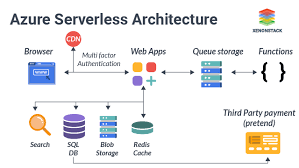
Behind every application, servers are responsible for handling requests, running business logic, and storing data. Traditionally, engineering teams had to:
-
Maintain physical or virtual servers
-
Apply OS and security updates
-
Handle scaling during peak traffic
-
Add monitoring and backups
With serverless, all of that responsibility moves to the cloud provider (AWS, Azure, Google Cloud, etc.).
Why Azure Functions? Key Benefits
1. Cost Efficiency
Pay only for the compute time you consume. No charges when your code isn’t running. This makes it ideal for workloads with variable traffic patterns.
2. Automatic Scaling
Azure Functions automatically scales based on demand. Whether you get 10 requests per day or 10,000 per second, the platform adjusts seamlessly.
3. Reduced Operational Overhead
Focus on writing business logic rather than managing infrastructure. No more worrying about OS updates, security patches, or capacity planning.
4. Rapid Development
Write functions in your preferred language (C#, Java, JavaScript, Python, PowerShell) and deploy quickly using familiar tools.
Core Concepts in Serverless Architecture
Understanding these terms will help you navigate any serverless platform:
Invocation
A single execution of a serverless function.
Duration
How long the function runs before finishing.
Cold Start
A delay occurring when a cloud provider initializes a function after a period of inactivity.
Concurrency
The maximum number of function instances running at the same time.
Timeout
The maximum allowed runtime for a single function execution.
Each cloud provider defines its own limits, but the underlying concepts are similar everywhere.
Serverless vs. Container-Based Architectures
Both serverless and containers abstract away hardware, but they differ significantly:
Containers
-
You manage the base image, runtime, and dependencies
-
Need orchestration tools like Kubernetes for scaling
-
Ideal for long-running or high-traffic applications
-
Best suited for lift-and-shift cloud migrations
Serverless
-
Cloud provider manages the entire infrastructure
-
Scales automatically based on triggers
-
Ideal for event-driven, short-lived tasks
-
Great for microservices and unpredictable workloads
In many real-world projects, teams use a hybrid approach, combining containers for core workloads and serverless for lightweight tasks.
Final Thoughts
Serverless architecture has become a preferred choice for organizations that want:
- Faster development cycles
- Highly scalable applications
- Minimal operational overhead
- Cost-efficient execution
But it’s equally important to understand the challenges -performance quirks, limited control, and vendor lock-in.
Businesses often adopt serverless gradually, integrating it where it provides the most value: automation, event handling, and lightweight backend tasks. When used correctly, serverless can dramatically simplify architecture and accelerate innovation.
The key to success with serverless is understanding both its strengths and limitations, and applying it to the right problems. Start small, experiment with different triggers and bindings, and gradually incorporate serverless patterns into your architectural toolbox.
Explore more with Learnomate Technologies!
Want to see how we teach?
Head over to our YouTube channel for insights, tutorials, and tech breakdowns: www.youtube.com/@learnomate
To know more about our courses, offerings, and team:
Visit our official website: www.learnomate.org
🎓 Interested in mastering Azure Data Engineering?
Check out our hands-on Azure Data Engineer Training program here:
👉 https://learnomate.org/training/azure-data-engineer-online-training/
Want to explore more tech topics?
Check out our detailed blog posts here: https://learnomate.org/blogs/
And hey, I’d love to stay connected with you personally!
 Let’s connect on LinkedIn: Ankush Thavali
Happy learning!
Ankush😎