



Heap Tables vs. Index-Organized Tables
Introduction
In the world of relational databases, how data is physically stored on disk has profound implications for performance, scalability, and operational complexity. The choice of types of storage structure determines everything from insert speed to query efficiency to maintenance requirements. Two fundamental storage architectures dominate the database landscape: heap tables and index-organized tables (IOTs). While both serve the same purpose—persistently storing data—they take dramatically different approaches to organizing that data on disk.
For database administrators exploring PostgreSQL for DBA practices, understanding these differences is essential. PostgreSQL exclusively uses heap tables as its native storage structure, while databases like MySQL (with InnoDB) and Oracle (with IOT option) offer alternatives. This article explores both approaches, their strengths and weaknesses, and why PostgreSQL’s architectural choice matters for database professionals.
What Are Heap Tables?
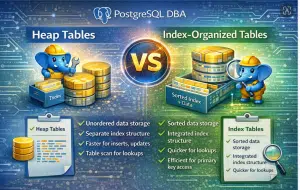
Heap tables, also known as heap-organized tables, store data in an unordered structure. When a new row is inserted, the database places it in the first available space that can accommodate it, without regard to any particular order. Think of a heap table like a physical filing cabinet where new documents are simply placed in any empty folder—there’s no inherent organization to where things are located .
Key Characteristics of Heap Tables
Unordered storage: Rows are scattered based on space availability rather than any sorting criteria. This means two consecutively inserted rows could end up in completely different physical locations on disk .
Index-data separation: Heap tables maintain a clear separation between the data itself and any indexes defined on that data. Indexes store pointers (called TIDs or rowids) that directly reference the physical location of rows in the heap .
No primary key requirement: Unlike IOTs, heap tables can exist without a primary key. This flexibility accommodates temporary tables, staging tables, or scenarios where a natural primary key doesn’t exist .
Default in major databases: PostgreSQL, Oracle (default), SQL Server (without clustered index), and many others use heap tables as their default storage mechanism .
What Are Index-Organized Tables?
Index-organized tables (IOTs) take a fundamentally different approach: the table itself is structured as a B-tree index. The data rows are stored directly within the leaf nodes of the primary key index, sorted according to the primary key order. In essence, the index is the table, and the table is the index—there’s no separate data storage area .
Key Characteristics of Index-Organized Tables
Ordered storage: Data is physically stored in primary key order. When a new row is inserted, it must be placed in the correct position within the B-tree structure, potentially causing page splits and reorganization .
Index as data: There’s no separation between the primary key index and the table data. The leaf nodes of the B-tree contain the complete row data, not just pointers .
Primary key mandatory: Every IOT must have a primary key, and that primary key defines the physical organization of the entire table .
MySQL InnoDB’s default: MySQL with InnoDB uses index-organized tables, calling the primary key index a “clustered index” .
Detailed Comparison: Heap Tables vs. Index-Organized Tables
Insert Performance
Heap tables excel at write-heavy workloads. Because new rows are simply appended to available space without maintaining any particular order, inserts are fast and predictable. There’s no need to find the correct position in a sorted structure or to reorganize existing data .
Index-organized tables face overhead during inserts. Maintaining the B-tree’s sorted order requires finding the correct insertion point and potentially splitting pages when they become full. This overhead can significantly impact write performance, especially for random insert patterns .
Query Performance
Primary key lookups favor IOTs. When querying by primary key, IOTs provide the fastest possible access—the data is found directly through the index structure without any additional lookup step. This is often called “avoiding the table access by rowid” .
Heap tables require an extra step for index access. Even when using the primary key index, heap tables must first locate the index entry, then follow the pointer to the actual data location. This adds one additional I/O operation compared to IOTs .
Range scans on primary key benefit both approaches differently. IOTs excel here because data is physically stored in primary key order, making sequential range scans highly efficient. Heap tables can still perform range scans efficiently if the index is used, but each row retrieval requires the extra pointer lookup step .
Secondary Index Behavior
This is where the architectural differences become most pronounced:
Heap tables support efficient secondary indexes. Each secondary index stores direct pointers (TIDs) to the physical row locations. When querying through a secondary index, the database can jump directly to the data in one step .
IOTs face a “double lookup” problem. Secondary indexes in IOTs cannot store physical pointers because rows can move during page splits. Instead, they store the primary key value of the target row. To retrieve a row through a secondary index, the database must:
-
Find the secondary index entry, obtaining a primary key value
-
Use that primary key to search the main IOT (another B-tree traversal)
This adds significant overhead for queries using secondary indexes .
Update and Delete Operations
Heap tables handle in-place updates efficiently. For fixed-length columns, updates can modify the data directly at its existing location. Deletes simply mark space as reusable .
IOTs face challenges with updates, especially to primary keys. Updating the primary key in an IOT essentially requires deleting the row from one position in the B-tree and inserting it at another position—a costly operation. Even updates to non-key columns can cause page reorganizations if they increase row size .
Storage Efficiency
Heap tables store data once, with indexes as separate structures. This avoids duplication for the most part, though each index maintains its own storage .
IOTs duplicate primary keys in secondary indexes. Every secondary index in an IOT stores the primary key value for each row. For tables with wide primary keys or many secondary indexes, this can significantly increase storage requirements .
Full Table Scans
Heap tables can be very efficient for full scans. If rows are stored contiguously (minimal fragmentation), full table scans can read data sequentially at disk speed .
IOTs may underperform for full scans outside primary key order. While scanning in primary key order is efficient, scanning the entire table for non-primary key conditions involves traversing the B-tree structure, which can be less efficient than heap’s sequential access .
Why PostgreSQL Chooses Heap Tables
PostgreSQL’s exclusive use of heap tables isn’t an accident—it’s a deliberate architectural choice that aligns with the database’s design philosophy and target use cases .
Alignment with MVCC Implementation
PostgreSQL’s Multi-Version Concurrency Control (MVCC) creates new row versions for updates rather than overwriting existing data. This approach works naturally with heap tables, where new row versions can be inserted into available space without reorganizing the entire table structure. An IOT’s requirement for ordered storage would conflict with PostgreSQL’s MVCC model, potentially causing excessive page splits and reorganization .
Flexibility for Diverse Workloads
PostgreSQL is designed as a general-purpose database serving everything from small applications to data warehouses. Heap tables’ flexibility—no mandatory primary key, efficient secondary indexes, good performance across varied access patterns—makes them suitable for this wide range of use cases .
Lower Maintenance Overhead
As discussed earlier, heap tables offer simpler maintenance operations. Vacuum processing, index rebuilds, and space reclamation can proceed with minimal impact on concurrent operations. This aligns with PostgreSQL’s philosophy of allowing 24/7 operation without scheduled downtime .
Ecosystem Compatibility
PostgreSQL’s heap-based architecture is well-understood by the broader open-source ecosystem. Tools, drivers, and applications built for PostgreSQL expect heap behavior, and changing this fundamental storage structure would break decades of compatibility .
Conclusion
The Learnomate Technologies YouTube channel is your free gateway to mastering PostgreSQL for DBA skills. Whether you’re troubleshooting a production issue, preparing for an interview, or building your career from scratch, our practical tutorials provide the knowledge and confidence you need. Subscribe today and join thousands of learners on their journey to PostgreSQL expertise!
Subscribe today and join thousands of successful database professionals who built their careers with Learnomate Technologies!